Sunday, May 5, 2013

Images for the Kent State Tragedy

 Neil Young "Ohio"


"Protesting the Vietnam War" 10/21/1967, photo by Frank Wolfe


Kent State students rally and protest
National Guard is deployed at Kent State University the day of the shooting

Pulitzer Prize winning photo by John Filo of
Mary Ann Vecchio as she discovered the body of Jeffery Miller
Clockwise from Top Left Allison Krause, William Schroeder, 
Sandra Schuer, and  Jeffery Miller


The Kent State Tragedy: Neil Young, "Ohio"

On May 4th, 1970, an infamously horrible event occurred which still shocks modern day Americans. A troop of National Guardsmen opened fire on a group of protesting college students at Kent State University in Kent, Ohio. More than sixty bullets were aimed into the young protesters, injuring nine and killing four. Four students, two boys and two girls, were only taking part in honoring their beliefs; lives came to a halt that day. 
Just like the Sandy Hook shootings a couple months ago, Americans were outraged at hearing the news of the student’s deaths. Their murders soon became a symbol for people all over the United States. They were a symbol of anti-war and peace. Their ideas were simple. No one cared who won the war, they just wanted to educate other people about all of the suffering and awfulness that would occur to either country by the time the war was over. A common saying by anti war protesters, even in previous wars, was "flowers are better than bullets." The massacre even led to the May 1970 Student Strike. 
The May 1970 Student Strike was a protest against the war in Vietnam that took place at the University of Washington and thousands of students participated. It lasted about eight days, with marches to Seattle, and attempts to occupy the whole University campus. It was a really big deal across the United States, especially for the soldiers and the pro war citizens. This is also a big reason that a lot of public outbreaks happened that was actually hostile towards college protesters. There didn’t seem to be a reason for all of these groups of mostly adults disliking college students until it was pointed out that a mass supply of college students were closely related to the anti-Vietnam sentiment activities. I believe that college students in general have always and will always be very opinionated. They are young and wild and free in simpler terms. They don’t have to worry about anything but themselves and they want to be heard. That is why they were obviously outspoken. Older people at the time of war still have opinions; they just aren’t so naïve as to blurt out everything. It is a blessing for students and sometimes, in this case for example, it can also be a curse.
            Although the papers say that they don’t know why the soldiers fired their guns, it is obviously not like the National Guardsmen were unprovoked. Being held by college students, these protests could very well get violent and even destructive. The reason the Guard was called in the first place was because the campus couldn’t handle the students anymore. They had recently burned down buildings and trashed the protest sights. They openly showed their dislike for the soldiers with obscene gestures and profane language towards the soldiers. The Guardsmen were only trying to control the rowdy crowd. However I do believe that they overreacted completely.
Even before the demise of William, Sandra, Allison, and Jefferey, the college protests had been the spark that ignited the anti-Vietnam sentiment across North America. The news completely divided the country socially and politically. During this war, you could fall into one of two categories based on your beliefs, "flower power" or pro war. Most of the Flower group was made up of students.
These divisions didn't just affect the normal citizens either, even celebrities had an opinion. Quite popular and commonly outspoken singer-songwriter, Neil Young, even wrote a hit song about it called "Ohio." People raged about that song for months after it was written. It was so unconventional that it was actually banned in different places for “‘anti-war’ and ‘anti-Nixon’ sentiments.” He was influenced by the Life Magazine from May 15, 1970, which covered the Kent shootings. This was not the first outgoing song that Young had created. Four years earlier, he co-wrote ‘For What It’s Worth,’ which was also extremely controversial, but well liked just the same.
            Over forty years later, people still remember this shooting. National Public Radio did an anniversary broadcast about the shooting that included survivors’ stories and eye witness accounts that led to more knowledge about the incident. Jerry Lewis was a teacher at the University and he was just really surprised when the bullets were fired. He honestly did not believe that the bullets were flying. Along with others, Lewis was just another witness to the monstrosity that happened on May 4th. No one ever did get tried for the murders of the four students. Justice will not be served until then in my opinion. Students were just lawfully speaking their minds about their ideas. Because of a trigger however, those are four less voices that will be heard today.


Bibliography

Wednesday, February 6, 2013

American Protective League

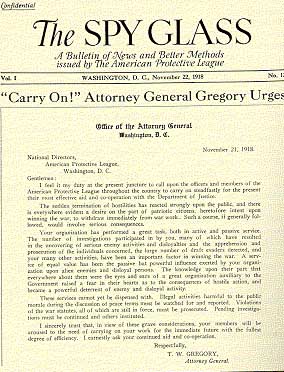
The American Protective League Newsletter
    The American Protective League was a group of volunteers who sought out anti-american activity in their neighbors, coworkers, and even family members, and reported them. It was headed up by a man named Albert Briggs, who was a Chicago advertising expert.He contributed a lot to the members, including payments, and cars so they could more easily watch the suspicious activity. Most Americans were infatuated with this idea that their surroundings were made safer because of this surveillance that the volunteers did. Some people even quit their jobs, just to solely devote their time to recognizing the threats that these double crossing German supporters!
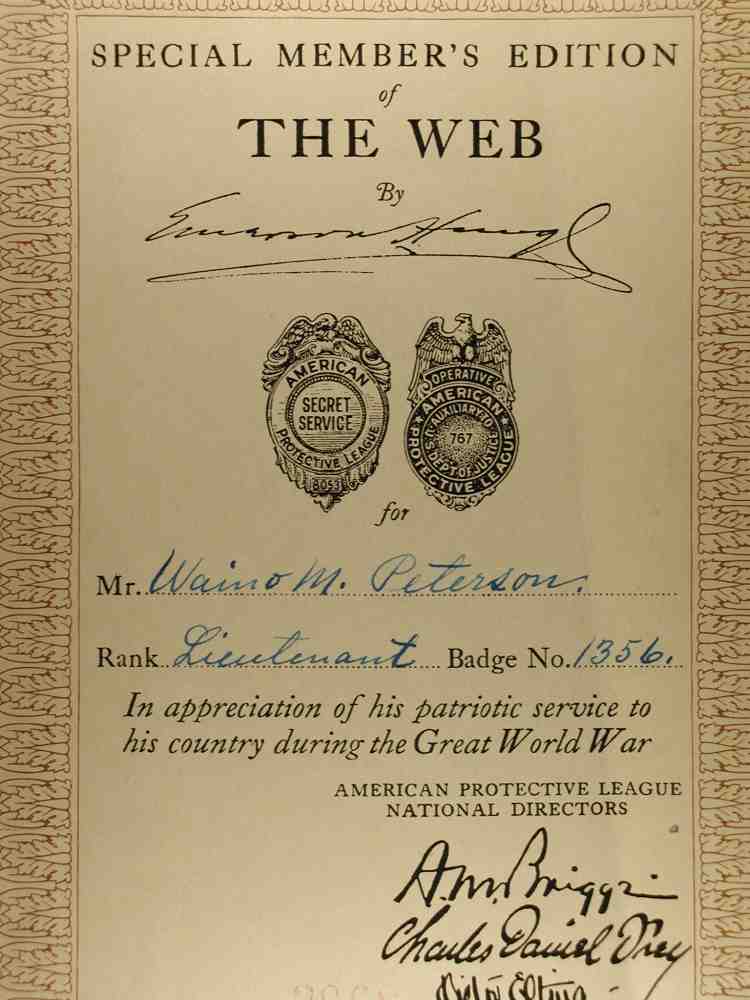
APL Special Members Certification
                       The volunteer group was under a branch of the FBI, and was allowed because President Wilson and the Attorney General Gregory both supported it. It was legal to spy on your neighbors because of the Sedition act. This organization was huge by the end of WWI, with eighty to one hundred thousand members (mostly white American men in the beginning) represented throughout the country, in over six hundred cities and towns. Mostly in large cities where large alien activity was happening. They even had a newsletter, called The Spyglass! The "web" as the people in this society called themselves, believed their duty was to relieve overall fear of foreign spies, immigrants, and terrorists. The Web was infiltrated in every single aspect of daily life that you could imagine, including corporate business people, construction workers,newspaper writers, artists, any job you can think of, the important part is that extremely powerful people were involved with this.
APL to U.S. Food Administration: 
Carl A. Rink


    The APL was highly praised in some places, like the government for conducting investigations for lots of federal agencies, or for finding different kinds of delinquents from the Draft. (Selective Service Act) However, they were also a largely criticized group, because of their blatant discrimination and racism against foreign peoples, and also their legalized hate crimes.  They spied on people just for having German surnames, and their are thousands of letters that were written to the head of the organization, the National Board of Directors, about how their friends, families, and neighbors were acting disloyal, disturbing, embarrassing, or harmful to the United States, or their government.  This would definitely be illegal today.There are instances similar to the Holocaust, where businesses and homes were burned down! The group was mostly peaceful though. 
The American Protective
 League Badge
 

    The way I would describe it would be similar to the National Guard today. Except, instead of protecting our citizens physically, they are infiltrating terrorists and the equivalent of Al-Qaeda supporters. At the time of WWI, though, many critics of this group would have compared them to  history repeaters, like the Sons of Liberty in the Civil War, the American Protective Association (which is similar, but failed ultimately), the Anti- Catholic Association, the Industrial Workers of the World, and because of their discrimination, some people have compared it to the Klu Klux Klan!
     The APL only lasted for about a year, from March 1918, two weeks before America joined WWI, to February 1919, when it was said to be out of control, and not necessary any longer by the Attorney General, and commanded to be dissolved. The Web members  badges and certifications were considered inane. Many members still had strong feelings about their dislike of suspicious citizens, but the activity surely died down. This was very interesting and I liked learning about it! However in my own opinion, I disagree with the people spying on anyone, other than the government looking at them.

Sources:
George Mason University. History News Network Civil Liberties, Joan Jenson
general information about the names and titles of people and also the league
Biltmore Industries Archive
   the size of the group
National Archives-records of the FBI
 details about the group status in the government


Wednesday, January 16, 2013

Monday, January 14, 2013

Homework Selfie!! / What is actually going on.

Well, I am currently working on a research project on the Great White Fleet! That was the title of the United States Navy when they went all around the world. President Teddy Roosevelt ordered them to so that they could intimidate all the other countries. I am creating six postcards, that resemble the messages that sailors would have sent to their families and friends from the various stops around the world. Also, Mary Morgan(left) is hanging out too.

Wednesday, November 14, 2012

American Psychology Advancements 1880-1920

    Psychology has been practiced throughout the history of the world ever since people started thinking about how the mind works and how thoughts happen. There have been both great and horrific acts taken towards the advancement of psychology in America, ranging from human testing to finding cures for diseases. During the turn of the twentieth century there was a rapid growth in technology advancements and funding for psychology.  People were having more time to study what they enjoyed than working in factories. There was better communication which brought new ideas to the states. All of these factors were what helped to reach for progress towards understanding the mind.
The McLean Asylum 1900
            When America was flourishing in work and leisure, more people started to do things that they enjoyed, like writing books and starting organizations for their passions. This can be paralleled with the Greek Empire when, once they actually got their society up and running, they could have more time to play, learn, and teach. In this time period, people became scholars and professors, much like the people around 1900. The expansion for every aspect of life was incredible, including skyscrapers and apartment buildings. Psychology was not left out. Buildings were springing out of the ground like daises in the springtime. The first psychology lab was established at John Hopkins University in 1883. Hospitals devoted to the Insane included: St. Elizabeth's, The McLean Asylum, and Hudson River State. Particularly the University of Pennsylvania was important because most of the American psychologists came from there, but also Indiana University, University of Wisconsin, Clark University, the University of Nebraska, and also Princeton are known for developing labs and departments solely for psychology.
Sigmund Freud
      1838 was also the year when the famous Inquires Into Human Faculty and Its Development was published by Francis Galton.  Soon after that, J. McKeen Cattel became the first professor of psychology at the University of Pennsylvania. Then, the American Psychological Association was founded. In 1900, Sigmund Freud published the Interpretation of Dreams. People were fascinated at this point. New Methods for the Diagnosis of the Intellectual Level of the Subnormals was published by Alfred Binet in 1905. Two years later, Carl G Jung wrote  The Psychology of Demeutia Praecox. An Interesting fact, is that these men were also becoming interested in other aspects than just how to fix weird people and how to control their own minds, they were looking at the tests for child intelligence, and even more interestingly, the animal mind. Binet and Simon were the professors working on the children I.Q. tests, which are still involved today, and Washburn was the man who wrote The Animal Mind.  Finally, in 1911, a man named Thorndike worked on the actual Animal Intelligence. This is where a lot of animal rights activists get the idea that animals have feelings.
NOT DONE YET. I PLAN ON ADDING:
  • talking about sigmund freud
  • the treatment of the patients, who are the patients, reasons why their the patients
  • the three types of Psychology ideas.
  • my other picture:)

Sources:

Wednesday, October 24, 2012

Immigrant(ism)

     When I watched Faces of America it helped me learn just how little someone can know about their own families. People in this video didn't even know important parts about their pasts, and about what created them as people. If their parents, grandparents, and uncles and aunts never came to America, when they did, most of them would not have been where they are today. This was very thought provoking to me, because it made me wonder just how little I actually know about my heritage. That was when I realized that I really do not know that much at all! I know that my grandmothers mom changed her German last name to Cutter when she immigrated, but I have know idea where she ended up or why she made the journey in the first place. I realized that I don't know anything at all about her husband's family. I also do not know anything about my other grandma's family, but I do know that my mom's dad has a very large amount of Cherokee in him. But this is about all I know. According to my Aunt, there are immigrants from France and Sweden in there somewhere too, but I feel the need someday to figure it out on my own.
     I do love the fact that I live in America though. It is a wonderful melting pot of immigrants and that is what creates every aspect of our nation. It is fantastic to hear that people would make such treacherous trips, sometimes leaving their whole entire lives behind, to get to a foreign country, which they know little about, to work arduously for the rest of their lives just to make a better one for their families. That is truly amazing. They brought their cultures and customs, some of which we adopted, like architecture and foods, and some that we rejected, like languages and religions. It is also very cool to be a part of a country where all of us can be called Americans, but few of us have the exact same backgrounds and ethnicity.
    Sadly, I do not really feel the connection to my ancestors. Its probably because mostly I do not know them, but that doesn't mean that I don't feel connection to the immigrants. We hear all about them in the presidential debates, and we see them quite literally everywhere, because they are a part of everyone. YAY America!

Thursday, October 18, 2012

Henry Ford

     As a young child, Henry Ford was given a pocket watch from his father as a present. Right when he got it, he took it apart and then he reassembled it. After hearing of this interesting ability, friends and neighbors called upon him to fix their timepieces.This officially sparked his lifetime love for machines.  He hated his measly farm life, and when he turned sixteen, he went to be an apprentice machinist with a man in Michigan where he learned to more skillfully operate steam machines and he also studied book keeping. Once he was grown and married, he switched back to the farm life in order to better support his family, until he got his first real job with the Edison Illuminating Company.
    He later gained the title of "Chief Engineer" at the company by sharing his ideas of a "horseless carriage" with Thomas Edison himself, who funded the research needed for Fords brilliant ideas. Once he broke away from Edison to further pursue his ideas he created the Ford Automobile Company where breakthroughs were made like the assembly line and the official automobile.
    His ideas as a manager of the company were to have a perfect working environment. He had a social department that checked into the lives of his employees to make sure they were making respectable choices and if they stayed at the company more six months, he even set up a profit sharing system for them. Because of his efficiency Ideas, his workers were the highest paid and time wise, the least working people around in the society.
     He also was a ardent pacifist who opposed WWI and he even went as far to fund a peace ship to Europe. However, his actions were also kind of contradictory because he was openly antisemitic, and he supported publicly The Dearborn Independent, an antisemitic weekly newspaper. He was a philanthropist though, and he created the Ford Foundation that funded ongoing grants for research, education, and development.
    I think that Henry Ford may have had his faults, (like his Nazi support...) he was an overall good person who forever changed our society. He made working conditions better, he worked hard to get to where he was, and he invested his noteworthy ideas that were powered by his love of steam machines and his dream in America.
     biography
     The Life of Henry Ford

Thursday, September 27, 2012

Roles Played By Native Americans in WWII

Native Americans played extremely important roles in WWII. Before this point in history, they were frowned upon by the majority of Americans, and there were not a lot of opportunities for them to gain prosperity or wealth. Jobs were not available to the Native Americans; that is if they were even trying to leave their reservations to search for work, which most were not. The attempts towards assimilation were beginning to be considered hopeless as the country approached the War. However, things started to change when President Roosevelt declared War on the Axis Powers in 1941.

When the Japanese attacked Pearl Harbor, more Indians joined the War cause than had ever before. There was a 40% increase of enlisting Indians than the rate in WWI, and that was only the beginning. By 1942, 7,500 Indians had joined in the overseas military forces, and they served in all branches of the war. A surprising 40,000 left their reservations; some for the first time ever, to search for jobs in defense Industries.  At the end of the war in 1945, 22,000 Indian men had voluntarily joined the war on the front, and over 150,000 Indians were back in the States helping the effort. They were gaining jobs in factories and hospitals, as well as foundations like the Red Cross. Some of the most generous donations were actually from the Native Americans, who gave almost all they had. This shows that even though throughout the history of America, and the horrible things that white Europeans did to these people, they still had a great sense of pride for their nation, and displayed strong patriotism. By the end of the war, 99% of available Native Americans registered for the draft, but sadly, they still weren’t allowed to vote. However, their successful endeavors helped to lead to many Civil Rights movements to come.

One of the most significant roles that Native Americans played during WWII was their contributions of code talking. The fact that the United States had this fantastic advantage over the Axis Powers was scary for the Germans. Since the Choctaw language was indecipherable in WWI, they sent spies over to reservations posing as anthropologists who actually tried to learn their languages and even go as far as telling the Indians not to register for the draft. To their disappointment, none of the codes were ever cracked, by the Japanese or the Germans. In fact, they were only made further more complex. During the war, there was a large recruitment of Navajo Indians, who came together over the period of two weeks in 1942 at a code talking “school “to further develop these codes, which were based off of the unwritten Navajo language. Something that I thought was interesting was that most of these battle messages were translated over the telephone.
                                                                                                                                                     "He who smells his mustache," and “the Gourd Chin," otherwise known to the Native Americans as Hitler and Benito Mussolini were two people who helped contribute to the modern day ideas about the swastika. Today, it is a symbol that represents fear, hate, and the Holocaust, but before WWII, this symbol was used frequently throughout the world. In many religions, like Christianity and Hinduism, and also in many cultures, like the Ancient Chinese, and European countries all have presented evidence that proves their use of the swastika. In Native America, this symbol was very similar to an Indian mystical bird that represents good luck, life, the sun, power, and strength. It was commonly paired with a famous Navajo myth called The Whirling Log. In this story, a man is trying to travel to reach an ultimate goal, but he has no way to continue his journey when he sees a river. So, to fix his problem, he hollows out two logs and paddles his way downstream in his makeshift boat to reach his destination. In that myth, the two whirling logs cross to form the swastika and represent his good fortune to find those logs, his power and strength to hollow and paddle, and his journey of life. The Native Americans used this symbol in many tribal objects, war armors, and many more objects alike commonly. Another example of how they overcame the pain that the white men put them through is that they officially discontinued the use of their sacred symbol in attempt to end the hatred being spread by the mustache smeller and the gourd chin man.

As you can see, the Native Americans played a crucial part in the fight against the Axis Powers of WWII. Without their fierce patriotism, unbreakable codes and languages, and readily helpful working hands, the outcome of the war would definitely be changed as we know it.

Sources:
National Museum of the American Indian
Department of Defense
US Navy
www.khandro.net