Wednesday, February 6, 2013

American Protective League

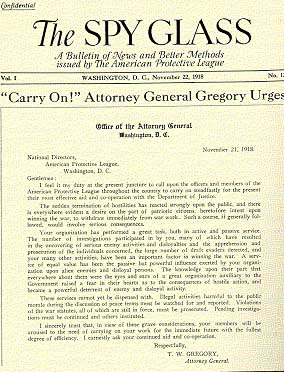
The American Protective League Newsletter
    The American Protective League was a group of volunteers who sought out anti-american activity in their neighbors, coworkers, and even family members, and reported them. It was headed up by a man named Albert Briggs, who was a Chicago advertising expert.He contributed a lot to the members, including payments, and cars so they could more easily watch the suspicious activity. Most Americans were infatuated with this idea that their surroundings were made safer because of this surveillance that the volunteers did. Some people even quit their jobs, just to solely devote their time to recognizing the threats that these double crossing German supporters!
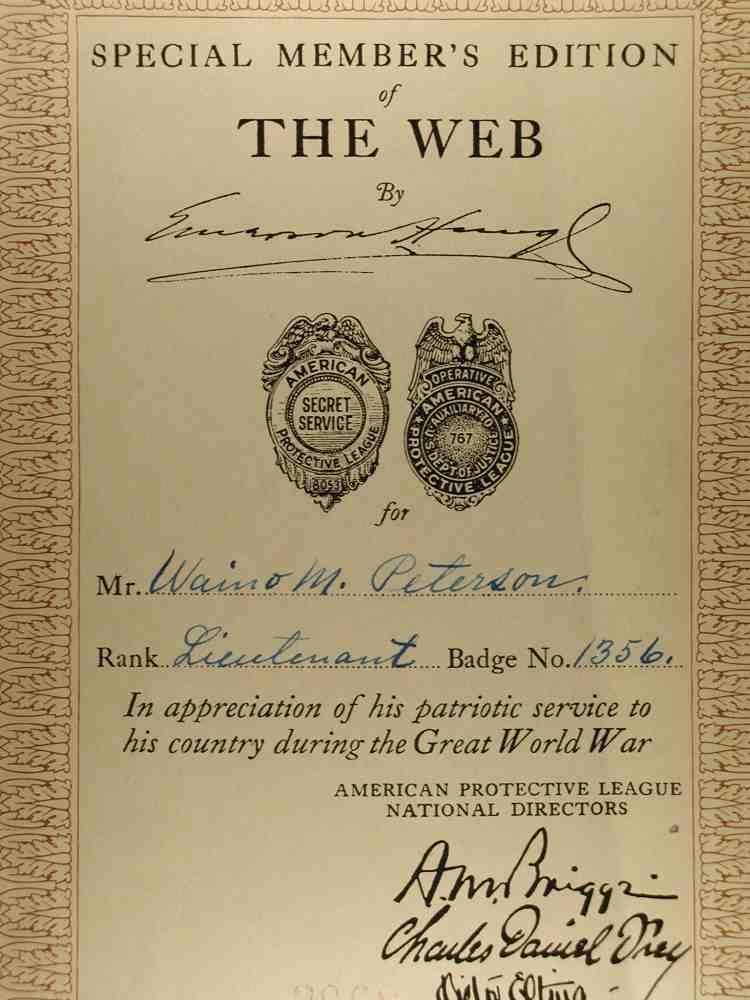
APL Special Members Certification
                       The volunteer group was under a branch of the FBI, and was allowed because President Wilson and the Attorney General Gregory both supported it. It was legal to spy on your neighbors because of the Sedition act. This organization was huge by the end of WWI, with eighty to one hundred thousand members (mostly white American men in the beginning) represented throughout the country, in over six hundred cities and towns. Mostly in large cities where large alien activity was happening. They even had a newsletter, called The Spyglass! The "web" as the people in this society called themselves, believed their duty was to relieve overall fear of foreign spies, immigrants, and terrorists. The Web was infiltrated in every single aspect of daily life that you could imagine, including corporate business people, construction workers,newspaper writers, artists, any job you can think of, the important part is that extremely powerful people were involved with this.
APL to U.S. Food Administration: 
Carl A. Rink


    The APL was highly praised in some places, like the government for conducting investigations for lots of federal agencies, or for finding different kinds of delinquents from the Draft. (Selective Service Act) However, they were also a largely criticized group, because of their blatant discrimination and racism against foreign peoples, and also their legalized hate crimes.  They spied on people just for having German surnames, and their are thousands of letters that were written to the head of the organization, the National Board of Directors, about how their friends, families, and neighbors were acting disloyal, disturbing, embarrassing, or harmful to the United States, or their government.  This would definitely be illegal today.There are instances similar to the Holocaust, where businesses and homes were burned down! The group was mostly peaceful though. 
The American Protective
 League Badge
 

    The way I would describe it would be similar to the National Guard today. Except, instead of protecting our citizens physically, they are infiltrating terrorists and the equivalent of Al-Qaeda supporters. At the time of WWI, though, many critics of this group would have compared them to  history repeaters, like the Sons of Liberty in the Civil War, the American Protective Association (which is similar, but failed ultimately), the Anti- Catholic Association, the Industrial Workers of the World, and because of their discrimination, some people have compared it to the Klu Klux Klan!
     The APL only lasted for about a year, from March 1918, two weeks before America joined WWI, to February 1919, when it was said to be out of control, and not necessary any longer by the Attorney General, and commanded to be dissolved. The Web members  badges and certifications were considered inane. Many members still had strong feelings about their dislike of suspicious citizens, but the activity surely died down. This was very interesting and I liked learning about it! However in my own opinion, I disagree with the people spying on anyone, other than the government looking at them.

Sources:
George Mason University. History News Network Civil Liberties, Joan Jenson
general information about the names and titles of people and also the league
Biltmore Industries Archive
   the size of the group
National Archives-records of the FBI
 details about the group status in the government


Wednesday, January 16, 2013

Monday, January 14, 2013

Homework Selfie!! / What is actually going on.

Well, I am currently working on a research project on the Great White Fleet! That was the title of the United States Navy when they went all around the world. President Teddy Roosevelt ordered them to so that they could intimidate all the other countries. I am creating six postcards, that resemble the messages that sailors would have sent to their families and friends from the various stops around the world. Also, Mary Morgan(left) is hanging out too.

Wednesday, November 14, 2012

American Psychology Advancements 1880-1920

    Psychology has been practiced throughout the history of the world ever since people started thinking about how the mind works and how thoughts happen. There have been both great and horrific acts taken towards the advancement of psychology in America, ranging from human testing to finding cures for diseases. During the turn of the twentieth century there was a rapid growth in technology advancements and funding for psychology.  People were having more time to study what they enjoyed than working in factories. There was better communication which brought new ideas to the states. All of these factors were what helped to reach for progress towards understanding the mind.
The McLean Asylum 1900
            When America was flourishing in work and leisure, more people started to do things that they enjoyed, like writing books and starting organizations for their passions. This can be paralleled with the Greek Empire when, once they actually got their society up and running, they could have more time to play, learn, and teach. In this time period, people became scholars and professors, much like the people around 1900. The expansion for every aspect of life was incredible, including skyscrapers and apartment buildings. Psychology was not left out. Buildings were springing out of the ground like daises in the springtime. The first psychology lab was established at John Hopkins University in 1883. Hospitals devoted to the Insane included: St. Elizabeth's, The McLean Asylum, and Hudson River State. Particularly the University of Pennsylvania was important because most of the American psychologists came from there, but also Indiana University, University of Wisconsin, Clark University, the University of Nebraska, and also Princeton are known for developing labs and departments solely for psychology.
Sigmund Freud
      1838 was also the year when the famous Inquires Into Human Faculty and Its Development was published by Francis Galton.  Soon after that, J. McKeen Cattel became the first professor of psychology at the University of Pennsylvania. Then, the American Psychological Association was founded. In 1900, Sigmund Freud published the Interpretation of Dreams. People were fascinated at this point. New Methods for the Diagnosis of the Intellectual Level of the Subnormals was published by Alfred Binet in 1905. Two years later, Carl G Jung wrote  The Psychology of Demeutia Praecox. An Interesting fact, is that these men were also becoming interested in other aspects than just how to fix weird people and how to control their own minds, they were looking at the tests for child intelligence, and even more interestingly, the animal mind. Binet and Simon were the professors working on the children I.Q. tests, which are still involved today, and Washburn was the man who wrote The Animal Mind.  Finally, in 1911, a man named Thorndike worked on the actual Animal Intelligence. This is where a lot of animal rights activists get the idea that animals have feelings.
NOT DONE YET. I PLAN ON ADDING:
  • talking about sigmund freud
  • the treatment of the patients, who are the patients, reasons why their the patients
  • the three types of Psychology ideas.
  • my other picture:)

Sources:

Wednesday, October 24, 2012

Immigrant(ism)

     When I watched Faces of America it helped me learn just how little someone can know about their own families. People in this video didn't even know important parts about their pasts, and about what created them as people. If their parents, grandparents, and uncles and aunts never came to America, when they did, most of them would not have been where they are today. This was very thought provoking to me, because it made me wonder just how little I actually know about my heritage. That was when I realized that I really do not know that much at all! I know that my grandmothers mom changed her German last name to Cutter when she immigrated, but I have know idea where she ended up or why she made the journey in the first place. I realized that I don't know anything at all about her husband's family. I also do not know anything about my other grandma's family, but I do know that my mom's dad has a very large amount of Cherokee in him. But this is about all I know. According to my Aunt, there are immigrants from France and Sweden in there somewhere too, but I feel the need someday to figure it out on my own.
     I do love the fact that I live in America though. It is a wonderful melting pot of immigrants and that is what creates every aspect of our nation. It is fantastic to hear that people would make such treacherous trips, sometimes leaving their whole entire lives behind, to get to a foreign country, which they know little about, to work arduously for the rest of their lives just to make a better one for their families. That is truly amazing. They brought their cultures and customs, some of which we adopted, like architecture and foods, and some that we rejected, like languages and religions. It is also very cool to be a part of a country where all of us can be called Americans, but few of us have the exact same backgrounds and ethnicity.
    Sadly, I do not really feel the connection to my ancestors. Its probably because mostly I do not know them, but that doesn't mean that I don't feel connection to the immigrants. We hear all about them in the presidential debates, and we see them quite literally everywhere, because they are a part of everyone. YAY America!

Thursday, October 18, 2012

Henry Ford

     As a young child, Henry Ford was given a pocket watch from his father as a present. Right when he got it, he took it apart and then he reassembled it. After hearing of this interesting ability, friends and neighbors called upon him to fix their timepieces.This officially sparked his lifetime love for machines.  He hated his measly farm life, and when he turned sixteen, he went to be an apprentice machinist with a man in Michigan where he learned to more skillfully operate steam machines and he also studied book keeping. Once he was grown and married, he switched back to the farm life in order to better support his family, until he got his first real job with the Edison Illuminating Company.
    He later gained the title of "Chief Engineer" at the company by sharing his ideas of a "horseless carriage" with Thomas Edison himself, who funded the research needed for Fords brilliant ideas. Once he broke away from Edison to further pursue his ideas he created the Ford Automobile Company where breakthroughs were made like the assembly line and the official automobile.
    His ideas as a manager of the company were to have a perfect working environment. He had a social department that checked into the lives of his employees to make sure they were making respectable choices and if they stayed at the company more six months, he even set up a profit sharing system for them. Because of his efficiency Ideas, his workers were the highest paid and time wise, the least working people around in the society.
     He also was a ardent pacifist who opposed WWI and he even went as far to fund a peace ship to Europe. However, his actions were also kind of contradictory because he was openly antisemitic, and he supported publicly The Dearborn Independent, an antisemitic weekly newspaper. He was a philanthropist though, and he created the Ford Foundation that funded ongoing grants for research, education, and development.
    I think that Henry Ford may have had his faults, (like his Nazi support...) he was an overall good person who forever changed our society. He made working conditions better, he worked hard to get to where he was, and he invested his noteworthy ideas that were powered by his love of steam machines and his dream in America.
     biography
     The Life of Henry Ford